· 5 min read
Games for anxiety: 10 calming games to help you unwind
Ten calming games for anxious evenings, from tiny town builders to gentle journaling games, what makes a game calming, and what research says so far.
Some evenings you're too wired to read and too tired to do anything useful. A good calming game can be the right size for that: something to hold your attention gently, without asking much back.
Not every game does this. Many are built to raise your heart rate on purpose. Here's what to look for, ten calming games worth trying, and a few honest notes on what games can and can't do for anxiety.
What makes a game calming
- No timers, or soft ones. Nothing chasing you, no countdown in the corner.
- No real way to fail. Or failing costs you nothing more than a retry.
- A simple, repeating action. Placing, sorting, walking, tending. Your hands stay busy while your mind settles.
- Good sound. Rain, wind, soft music. Sound does a lot of the calming work.
- A natural place to stop. A day ends, a puzzle is done, a page is finished. Games that never let you stop can keep you up instead.
What research says
Research on games and mental health is young, but there are some promising findings.
- A review of 35 studies found that playing video games, including ordinary commercial ones, can help train emotional skills as well as cognitive ones in healthy adults (Pallavicini and colleagues, 2018).
- Researchers at Oxford have studied Tetris as a way to reduce intrusive images after watching a distressing film. Because Tetris uses the same visual "space" in the mind as those images, it seems to crowd them out (Holmes and colleagues, 2009).
None of this makes a game a treatment for an anxiety disorder. But as part of an evening wind-down, a calm game is a reasonable choice.
10 calming games to try
1. Townscaper
You click on the water and little houses appear, stacking into a colourful island town. There are no goals, no score and no ending. It's closer to doodling than to playing, which is exactly why it works on a busy mind.
2. A Short Hike
You play a small bird on a weekend trip to a park, trying to reach the top of a mountain. You can head straight for the peak, or wander off to fish, chat and find shortcuts. It's short enough to finish in an evening or two, and it ends gently.
3. Unpacking
You unpack moving boxes into new rooms, one move at a time, across years of someone's life. There's no timer and no wrong way to arrange a kitchen drawer. The story is told only through the objects you unpack, and it's quietly moving.
4. Dorfromantik
You place hexagon tiles of fields, forests, rivers and villages to grow a peaceful landscape. Each tile is a small decision with no pressure. Rounds have a natural end, and there's a creative mode if you just want to build.
5. Alba: A Wildlife Adventure
You spend a summer on a Mediterranean island as a young girl photographing birds and animals and helping to save a nature reserve. It's warm, slow and full of birdsong, and the small tasks give you a gentle sense of doing something good.
6. Kind Words
You write short anonymous letters about what's on your mind, and reply to letters from strangers with something kind, to a lo-fi soundtrack. It's one of the few games built around writing your feelings down, and reading other people's kindness can be surprisingly comforting.
7. Spirit City: Lofi Sessions
A cozy focus companion rather than a game you "play". You sit in a small room with lo-fi music, rain and a crackling fire, and use its timer, to-do list, habit tracker and journal while you work. You collect little spirits and earn XP for good habits along the way.
8. Stardew Valley
The classic cozy farming game: plant crops, care for animals, fish, and get to know a small town. Days do end, so there is a little time pressure, but nothing is lost if you take things slowly. One or two in-game days make a good evening ritual.
9. Tetris Effect: Connected
Tetris, wrapped in music and visuals that react to every move. It can be intense at high speed, but its slower, relaxed modes are very soothing. Given the research above, it's an interesting choice for a busy head.
10. Leaf by Leaf
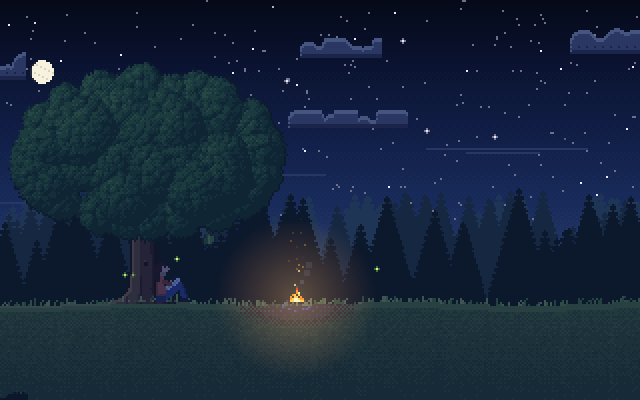
Full disclosure: this one is ours. Leaf by Leaf is a cozy pixel-art journal that you play. You sit with a character under an old tree, by the sea, at a cabin or by the fire, and answer a few plain questions about your day. When something is bothering you, Untangle a thought walks you through the CBT thought record in seven short pages, and at the end the tree lets the leaf go. Sessions take two to eight minutes, so there is always a natural place to stop.
You can try it on the home page without buying anything. Nothing you write there is saved or sent.
How to use games to wind down
- Choose your game before you're exhausted. When you're very tired, it's easy to fall back on whatever is most stimulating.
- Decide when you'll stop. One day in Stardew, one round in Dorfromantik, one page in a journal.
- Keep the sound on. Headphones help. The sound design is often the most calming part.
- Make it a ritual. The same game at the same time each evening becomes a signal to your body that the day is ending.
When games become a way to hide
Games can be a healthy break, and they can also become a way to avoid things that need attention. If you notice you're playing to avoid sleep, people, work or feelings night after night, that's worth noticing kindly, not with guilt. Try a few minutes of journaling for anxiety before you start, or one of the quick resets in how to calm anxiety fast.
And if anxiety is making daily life hard, please talk to a doctor. It's very treatable, and our plain guide to CBT explains one of the main treatments.